
Bucolic Coastal Paradise



A Summa Digest of Lamu
Kenya’s ultimate escape from crowds, noise, and modern stress – at the coast – Lamu, is as inimitable as it is obscure, much of it untravelled. Generally speaking Lamu County is rural, of many extremes in wealth, perspectives and development thanks to the combination of geographical, economic, political, and social factors. Long isolated from the outward and forward-looking coastal hubs of Malindi and Mombasa, in remotest Kenya contiguous with Somalia, Lamu has resisted change, preserved its heritage, and maintained its centuries old tradition. You’ll see many things for the first time! To start with, it is a car-free bucolic paradise with ancient stone towns, dhows sailing on turquoise waters, and endless salubrious beaches.
Lamu Island, the center of interest for many vistors to the county, situated along the southeastern area, is reached via boat either from Mokowe Jetty for those approaching it by road from Malindi, or via the Manda Jetty for those flying in to Manda Airport. Lo and behold! You are blasted back to the past. Once in Lamu town, you will find history unfolding round every corner. The little town, consisted of a maze alleys and sombre grey-coral-rag houses sometimes enlivened with ornately carved doors, a UNESCO World Heritage Site, has incredible history.
For the intrepid history buff, everything about Lamu town appears unique. Its natural beauty and laid back tenor draw you in eager to experience its charm and old-world chapters. The climate is pleasant, with coconuts and other palms fairly plenty, and the brisk breeze coming in from the Indian Ocean fans the traveller as they enjoy pleasurable walks through the central street, leading to the spines of narrow alleys into various wards, to experience the centuries old history. It is very probable that Lamu, which offered obvious advantages as a port, was continually occupied since the 8th century: With a fair amount of traditions and chronologies, in accurate detail, representing its colonization in the 10th and following centuries.
Safe streets also lead out to empty beautiful beaches, and at all times to the warm welcome and quiet hospitality of the Swahili folk with their fascinating customs – which come across as the most amusing of it all. Along Kenya’s coast, the dialect of Lamu is widely considered the best by locals, a quality that becomes apparent to anyone who has visited other coastal hubs. Not easily accessible and heavy with the patina of time, Lamu has remained relatively undisturbed by colonization, modernization and even mass tourism. From Lamu town the traveller may visit Shela, Manda and Pate Islands, and enjoy boat trips and walks through the island villages, resorts, markets, ancient monuments, ruins and lovely empty beaches.
At Shela, 2 km south of Lamu town, you’ll also find history unfolding round every corner. Here, too, the quaint village is consisted of a maze of alleys and sombre grey coral-rag houses sometimes enlivened with ornately carved door. With a medley of hotels and rentals mingled within, Shela is often-times the first target and center of living for most visitors to Lamu. All round the village are clusters of leggy and dreamy palms growing in the sand, rustling with a pleasant murmur that is so gratifying and uplifting to the senses. Palm grows all along the coast, but the best localities are said to be the Lamu Archipelago and at Tiwi south of Mombasa.
The archipelago embraces many islands, big and small, the largest being Lamu, Manda and Pate. The islands are mostly flat, and contain settled or abandoned towns. In all there are 65 islands with 130 km coastline and a marine extent expanding over 308 km2. The prosperity of the mainland through history is somewhat fluctuating. Many villages on the mainland suffered much in the past from the raids of the Somalis. “It is no doubt for this reason that so many towns have been built on the islands, as in this region the Somalis do not use boats”.
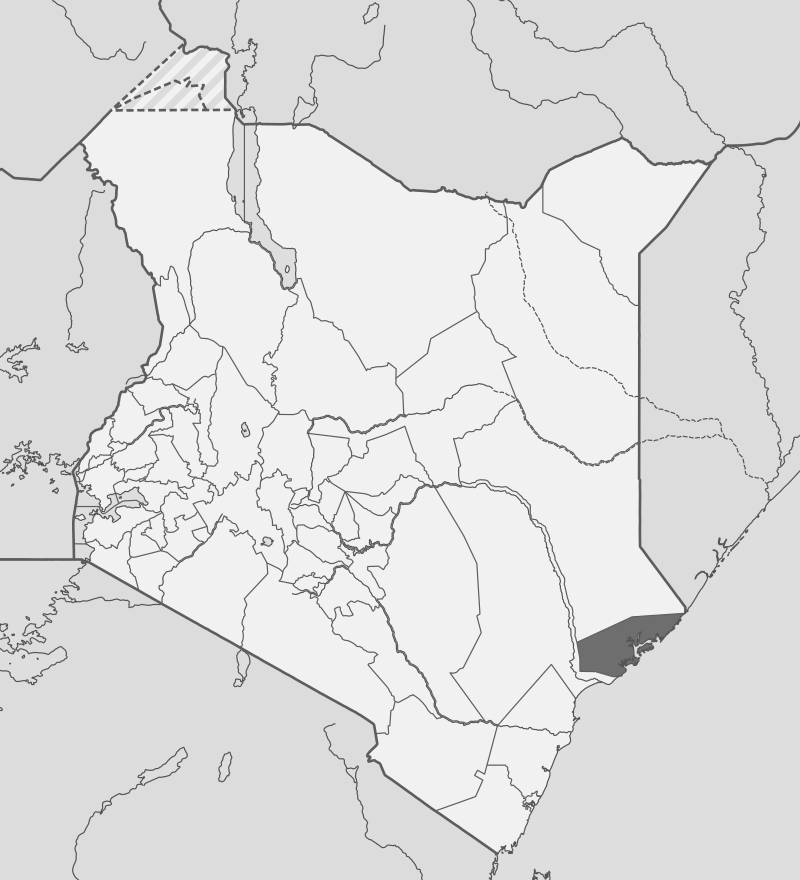
Much of the sickle-shaped Lamu County, bordered on the northeast, east and southeast by the Indian Ocean, is generally flat, at between 0 to 50 ms asl, with a land surface area of 6,273 km2. Next to its mainland, 65 islands (Archipelago), and 130 km coastline, Lamu County also holds a marine territory spread over 308 km2. Lamu town on Lamu Island is its capital. Lamu County borders Tana River County to the southwest, Garissa County to the north, Somalia to the northeast, and the Indian Ocean to the south. The population is small 143,920 as at 2019.
Of a more recent development, the new and modern Port of Lamu, plying the 39 fathoms (234 feet) deep Lamu-Manda Channel, is inevitably set to change the face of Lamu Island and the surrounding areas. As you would expect, this has naturally been received with some angst and antipathy; that the Lamu Port will but destroy the history, heritage and customs of Lamu. The lingering trauma is portrayed by grounded feelings of displacement, dispossession and alienation.
Another weighty development that has been more solicitously received is the completion of C112 Garsen-Witu-Lamu Road, linking Lamu County with Tana River and Kilifi counties. The 225 km drive from Malindi to Mokowe through Minjila was, for too long, all-weather and in fact in good state. However, during rainy seasons it was regularly breached by flood-water. Certainly, the 20th century has indeed reached Lamu. It will change the socio-outlook of the islands for better or worse.
Salient Features of Lamu County
- County Number 05
- Area – 6273 km2
- Altitude – 1010 ft
- Major Towns – Lamu, Shela, Manda
- Borders – Kilifi, Garissa, Tana-River

Lamu County is one of Kenya’s most unique and enchanting regions, known for its rich Swahili culture, pristine beaches, and UNESCO-listed heritage. Located on the northern coast of Kenya, it consists of a group of islands (Lamu, Manda, Pate, and Kiwayu) and a stretch of mainland coastline. Lamu Island in particular is more than just a destination—it’s a living piece of Swahili history and coastal paradise.
You Are Here: Lamu County
Where to Next?
Explore Destinations in Lamu County
A Guide to Lamu County


A Summa Digest of Lamu

About Lamu Way Back When

70 Destinations in Lamu County, arranged as one would visit these - west, south, north then west - with aid of narratives, images, strip maps and distance chart:

Delta Dunes Lodge, Lake Moa, Old Town Witu, Witu Forest Reserve, Pangani Swamp, Lake Kiboko, Amu Ranch, Lake Amu, Kipini Conservancy, Lake Kenyatta, Amu Baharini Beach, Kizuke Beach, Lamu (Manda) Port, Red Pepper House, Lamu Island, Matondoni Dau Workshop, Matondoni Ruins, Tusitiri Dhow, Kipungani Ruins, Kizingoni Beach, Old Town Lamu, Lamu World Heritage Sector, Lamu Museum, The Swahili House Museum, German Post Office Museum, Lamu Fort, Lamu Market, Masjid Khoja Ithnasheri, Masjid Riyadha, House of Habib Swaleh, The Mosque College Lamu, Lamu Catholic Church, Tamarind Tree Cafe, Donkey Sanctuary, The Floating Bar, Boat Rides, MaraRaha, Kijani Hotel, Shela Village, Friday Masjid, Forodhani House, Peponi Hotel, Shela Beach, Bahari Restaurant, Fort at Shela, Ras Kitau, Diamond Village, The Maljis, Takwa Ruins, Manda Island, Manda Lodge, Manda Toto, Manda Coral Quarry, Nabahani Ruins, Pate Island, Shanga Ruins, Siyu Fort, Shindamweh, Atu Ruins, Chundwa Ruins, Faza Village, Lamu Monuments, Mangrove Forests, Dodori National Reserve, Kiunga Marine N. Reserve, Kiwayu Island, Ashuwei, Boni Forest National Reserve, Ishakani Ruins, Lamu Festivals

Know More About Lamu County: Its Geography, Land-Use, Highlights, Population, Roads - including distance chart, Airports, Climate & National Monuments

What’s The Air Like In Lamu?
Lamu County lies along the Equatorial Climate System, enjoying two rainy seasons and temperatures between 24°C and 30°C year round – Hottest in December & April


What’s The Lay Of The Land In C.05?
Lamu is composed of a coastal zone of 65 islands, vast creeks, bays, sand bars and mangrove. Among these, Lamu Island, hosting Lamu Town, is the bussiest. The mainland is flat to undulating.
 Abiri Kenya