
Attractions in Nairobi County
19. The Giraffe Manor
Raised in 1932 as a residence for Sir David Duncan Mackintosh, the 12-rooms Scottish style hunting lodge set on 13-acres with austere views of Ngong Hills is today one of the amazing hotels in Kenya, and part of The Safari Collection. It is internationally recognized as a singular experience in Africa. Unique to Giraffe Manor in the northern area of Giraffe Center is the unmatched interaction with the resident giraffes which gracefully roam in and out the property. Most of the time these giraffes enjoy a limitless buffet of leaves but, they are never shy of popping in for a bite with the guests through the large dining windows. Granted that there are many modern touches within the Manor, it has retained much of the original 1930’s character and preserved its colourful and charming history. Each of its 12 rooms are uniquely outfitted to potray a piece of Kenya’s golden safari days. One of its rooms is named after Karen Blixen, the world-famous penman of Out of Africa. Then, there the Betty’s Suite named after one of the smallest and prettiest giraffes in the Center born in 2000, and which in turn was named after Betty Leslie-Melville a previous owner of Giraffe Manor (1974-2009). Other suites include the Finch Hatton Suite, Hellen Superior Room and Kelly Superior Room. Each room has a private veranda overlooking the forest, hillscape and park. Some of the high flying names that have stayed here include Ellen Degeneres, Mick Jagger, Walter Cronkite, Johnny Carson, Brooke Shields, Richard Chamberlain, Richard Branson, Ewan McGregor and Charlie Boorman.

20. David Sheldrick Elephant Orphanage
In her deeply heartwarming memoir “Love, life, and elephants: An African love story”, Daphne Sheldrick passionately recounts her remarkable life and career as a conservationist and introduces the world to a different sphere of elephant conservation, which she described as the “human-animal”. Her spirited efforts have won the hearts of many who visit David Sheldrick Elephant Orphanage. Established in 1977, in honour of David Sheldrick – one of the celebrated game conservationist in Kenya and the founder warden of the Tsavo National Parks – as a haven for rhino and elephant orphans as well as other animals, it is today a world’s success anecdote in the conservation of wildlife. “The elephants, whose development shares certain parallels with that of humans, are raised in hybrid human–animal herds, with male keepers taking the place of matriarchs in the surrogate setups. These men shadow the elephant calves, feeding them milk every three hours and even sleeping with them at night”. It is open to the public for one hour daily between 11 am and 12 pm. It is located 6 kms from Galleria Mall, via Magadi Road, near Multimedia University and Mbagathi Gate to NNP.
21. Karen Blixen Museum
Many on leaving the David Sheldrick Elephant Orphanage double-back along Magadi Road turn left on Bogani East Road and drive to its end to join Karen Road for a drop-in on the Karen Blixen Museum – the former residence of the exceptional penman of Out of Africa. Born Karen Christenze Dinesen on April 17th, 1885, in Denmark, Karen arrived in Kenya during WW1 in 1913, where she spend her next 17 years at this house – the centre piece of a 4500-acres farm at the foot of the Ngong Hills – before returning to Denmark in 1931. She would later rivet and tantalize many a reader with her exotic descriptions of Kenya’s beautiful landscapes in the bestseller Out of Africa, released in 1937 soon after returning to Denmark. Still and all, Karen Blixen would go on to become the most rhapsodized about aristocratic settler in pre-independent Kenya. Her residence, which displays her atypical and punctilious styling, was converted to a museum in 1986 soon after the adaptation into screenplay of Out of Africa in 1985. It’s open daily from 8:30 am to 6 pm and found 2 kms from Karen Center.
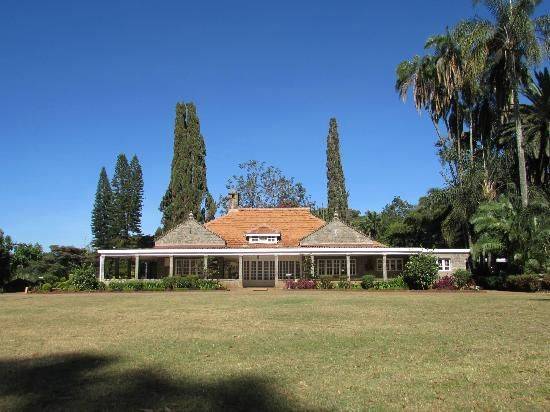
Karen’s misfortune was not that she was an aristocratic lady with exquisite manners which did not fit in with the present day’s taste. Her otherness was older and went deeper. Even in her great days in Africa a friend could say to her: ‘Life will never make a tune for your dancing.’ And she went to Africa because she felt like there was nobody in Denmark or Danish intellectual life who knew her and could respond to her nature. – A Portrait of Karen Blixen
22. Swedo House
A visit to Karen Blixen Museum should not omit a visit to Swedo House, located just down the road. Built in 1906, the quaint Swedo House located at the Karen Blixen Coffee Garden and Cottages was Karen Blixen’s initial and brief hunting lodge and farm house soon after her arrival in Kenya, after she acquired part of the 6000-acres Swedo-African Coffee Company. It was later designated as the farm manager’s house. “While over the years Karen’s coffee farm was split up to form today’s Karen Estate, her farm house and the manager’s house have been preserved”. Also at the site, is the historic Grogan MacMillan Manor House that was painstakingly moved, brick by brick, from Chiromo to the Swedo House in 2008 to save it from destruction. Hand in glove, these collection of buildings preserve the prodigious history associated with the broad forepassed pattern of European settlement and incipient farming in Kenya. It’s found off Karen Road.
23. Oloolua Nature Trail
Also of interest near Karen Blixen Museum, Oloolua Nature Trail is one of the great walking destinations in Naiorbi. It contains a 5 kms walking trail through the unblemished Oloolua Forest, which was once used by the Mau Mau fighters during pre-independent Kenya. The 400-acre Oloolua Forest is also remarkable for its beautiful waterfalls draining into the Mbagathi River, its caves, and its bamboo forest rest point. It is this river which offers the major attraction to the visitors as it changes course along the indigenous tropical dry Oloolua Forest, slow winding alternating with rocky rapids, with its woodland fringes forming canopies of deep shade which offer welcome relief and tranquility. The Trail’s headquarter is at the Institute of Primate Research (IPR), a non-governmental organization, under the care of National Museums of Kenya, which undertakes research on bio medical and animal welfare. The Institute also carries out a host of educational activities centered on ornithology, entomology and geology. It is located about 500 metres from the corner of Bogani East Road and Karen Road.
24. Kazuri Beads
A significant stride was taken in 1975 in the promotion of ceramic bead jewelry and hand-crafted pottery when Kazuri Beads launched as a modest workshop experimenting in hand crafted ceramic beads. “Today Kazuri has grown in leaps and now has a significant workforce of over 340 women skilled in the crafting of ceramic beads, strung into beautiful and artistic jewelry”. The object of Kazuri Beads, which runs its operations from a rustic shelter, is to support its family of ceramic bead experts who hand-make and hand-paint exquisite and baroque African jewelry. Every visitor, on arrival, is immediately impressed by both the intricate workmanship and the sociable and the friendly atmosphere. In fact, its founder Susan Wood intended just that; to engender a medium of employment especially for struggling and deserving mothers. Kazuri in Swahili means “small and beautiful”. It is found in part of what used to be Karen Blixen Estate, along Karen Road and off Mbagathi Ridge, about 1.4 kms from Karen Blixen Museum.

 Abiri Kenya