
A Birdwatchers Guide to Birding in Kenya

Birding in Kenya – The Long and Short of It
Birding in Kenya is one of the finer outdoor activities, the ornithologists priding themselves on a healthy selection of great locations in Kenya for spotting birds. ‘The job’, they say, ‘is to not blink and be as patient as it takes’. By all accounts, in recent times, the art – or pattern – of birding, or birdwatching as some may want to call it, has grown. With the result startlingly good. It has become one of the most promising ideas away from the traditional game safaris.
There are as many kinds of birders as there are birds. They range from intense perfectionists who travel the globe at the drop of a hat to see a species never seen, to a casual weekend hobbyist who enjoys watching birds at a backyard feeder or a nearby greenbelt. With 11% of the planet’s bird species, almost 1,100 different varieties, Kenya is not a shabby birding destination either. Many birders take to its most promising birding destinations at the lakes on the Rift Valley System, a World Heritage Site, to some of the world’s great ornithological areas.
The catch here is that, the hundreds of thousands of flamingo lining these lakes are the center of interest. Even if the newbies don’t understand how the birding thing works, it’s hard not to be intimately drawn. But even without the flamingo at the Lakes (Magadi, Naivasha, Elementaita, Nakuru, Bogoria, Baringo, Logipi and Turkana), the remaining birdlife is still fabulous – the pelicans, cormorants and fish eagles, among many. For the uninitiated birders [most of us] watching for birds is like to trying to decipher an impenetrable language.
Even so, birds appeal to our intellectual curiosity, most of us inherently drawn to the dazzling and divergent beauty of birds, their complex behaviour and varied songs; each as singular, evocative and pleasing to the ear. In fact, just a few visits on birding excursion lets almost anyone to adapt new skills without learning intervention. More than that, you don’t have to be rich to go birding. All you really need is a great location, a good guide, and a pair of binoculars. The real beauty of birding is that it presents an intellectual challenge because there are vast species.
Kenya Lake System in the Great Rift Valley
“Kenya Lake System in the Great Rift Valley, a natural property of outstanding beauty, is comprised of three interlinked relatively shallow lakes (Lake Bogoria, Lake Nakuru and Lake Elementaita) along the Rift Valley and these cover an area of 32,034 hectares. The property is home to thirteen globally threatened bird species and some of the highest bird diversities in the world. It is the single most important foraging site for the lesser flamingo anywhere, and the nesting and breeding site for great white pelicans.
Almost 1.5 million flamingo moving from one lake to the other. The lakes are also home to not less than 100 species of migratory birds and support globally important populations of Black-Necked Grebe, African Spoonbill, Pied Avocet, Little Grebe, Yellow Billed Stork, Black Winged Stilt, Grey-Headed Gull and Gull Billed Tern. This is an integral part of the most important route of the African-Eurasian flyway system where billions of birds travel to from the northern breeding havens to African ‘wintering’ sites.
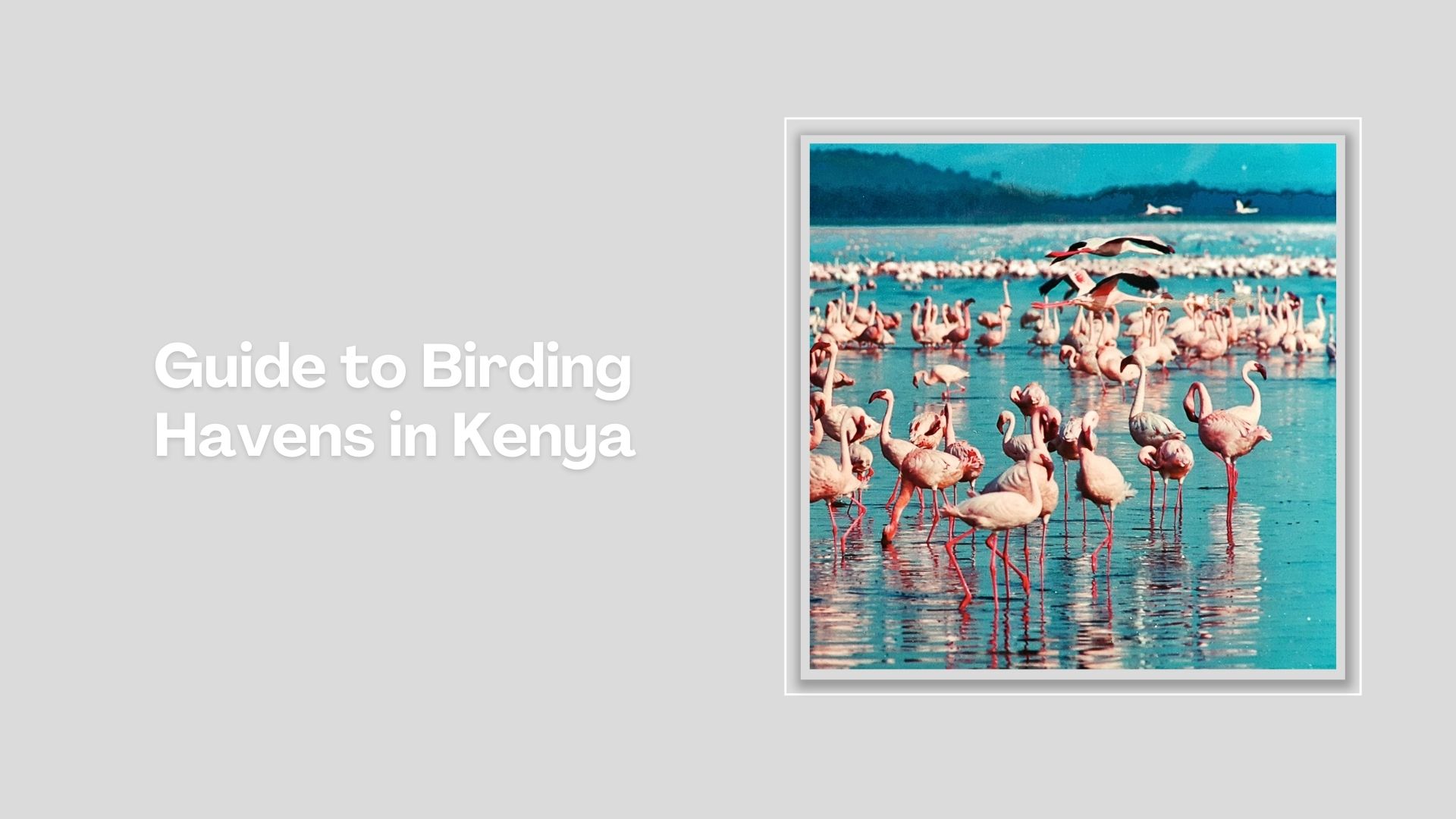
Birding in Kenya offers enthusiasts and nature lovers a chance to observe diverse bird species in stunning natural settings. Whether exploring the forests, wetlands, savannas, mountains, or coastal areas, birders can experience the thrill of spotting variegated, rare and endemic birds while contributing to their conservation.
Index of Birding Sites in Kenya


Baringo County - Lake Bogoria Reserve, Lake Baringo Reserve, Bomet County - Trans Mara Forest, Bungoma County - Mount Elgon National Park, Busia County - Sio Siteki Swamp, Samia Hills, Embu County - Mwea National Reserve, Homa Bay County - Mbasa Islands, Kajiado County - Lake Magadi, Kakamega County - Kakamega National Reserve, Isecheno Nature Reserve, Kericho County - Chagaik Arboretum, Kiambu County - Kereita Forest, Kilifi County - Arabuko Sokoke Forest Reserve, Mida Creek, Falconry of Kenya, Sabaki River Delta, Dakatcha Woodland, Kisii County - Nyangweta Forest, Kisumu County - Kisumu Bird Sanctuary, Ndere Island National Park, Kitui County - Mumoni Hill Forest Reserve, Laikipia County - Mukogodo Forest, Lamu County - Lake Kenyatta, Meru County - Nyambene Forest Reserve, Narok County - Ewaso Narok Wetland, Nairobi County - Raptor Rehabilitation Trust Kenya, Nakuru County - Nakuru Owl Center, Crater Lake Camp, Lake Elementaita, Lake Nakuru National Park, Nyandarua County - Sharpe's Longclaw Nature Reserve, Nyeri County - Wajee Nature Camp, Siaya County - Yala Swamp, Dominion Farm Bird Sanctuary

Birds are the eyes of Heaven
The fun. The really fun thing about birding, is the challenge to identify as many birds as you can. And there are many species to contend with. Ornithologists estimate there are between 9,000 and 10,000 species of birds across the world. So if there’s one trait where birdwatching can’t be surpassed, it’s variation. But there are also lots of clues to aid the birder pick them out: Sound, color, shape, size, place of sighting, behavior cues, time of year, time of day.
What’s more, the unconstrained nature of birding makes checking of the list relatively easy. That means that it can be mingled with most outdoor pursuits simply by keeping a watchfulness on the landscape. It can be a shared hobby among family, friends and birding companions, but rather commonly you can compete with yourself. “Not to mention the hand-eye coordination you develop when using binoculars on a moving object.
You have to be nimble to get on to the bird and to get your binoculars focused correctly. Flying birds, especially those that fly away from the observer, present special challenges. Birding, as a sport is non-consumptive and nondestructive to the environment. It results in no negative impact on the environment, and doesn’t harm the target in any way. Spotting and identifying a bird – even when misidentifying a bird – does not hurt anybody or anything”.

 Abiri Kenya